The short answer: a different system from temporary residence
If you are not an EU citizen but you live in Poland with a family member who is a citizen of another EU or EEA country or Switzerland, you do not apply for an ordinary temporary residence permit. You follow the EU free-movement rules instead and apply for a residence card for a family member of an EU citizen, known in Polish as karta pobytowa członka rodziny obywatela UE.
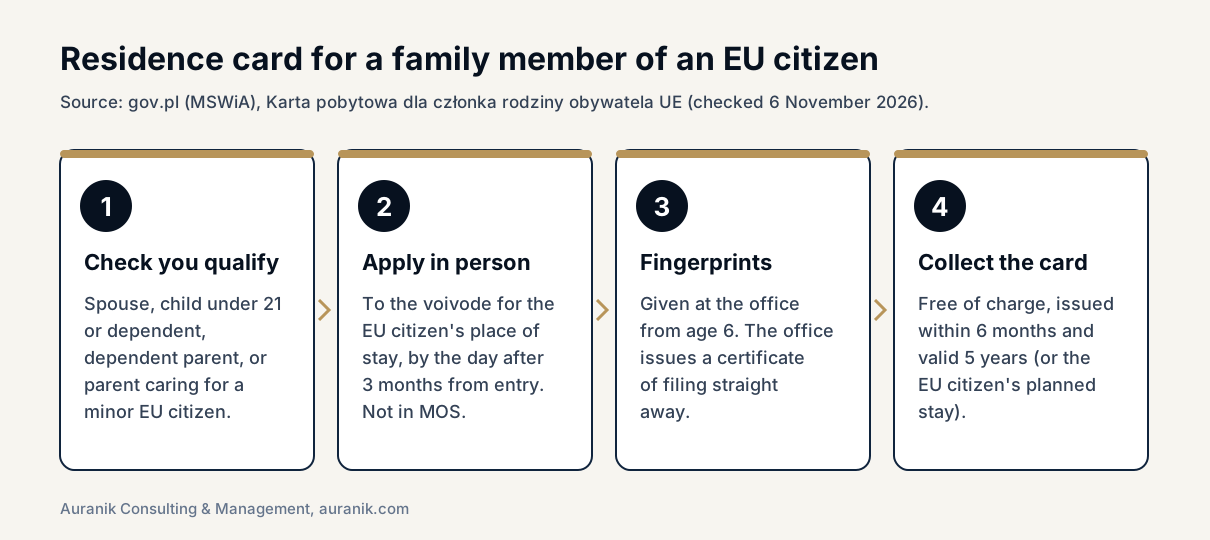
The card confirms your right of residence, which flows from your family link, and together with a valid passport it lets you cross borders without a visa. According to the Ministry of the Interior (MSWiA) page on gov.pl, the card is free, it is applied for in person rather than in MOS, and it is generally valid for five years.
Who counts as a family member
Article 2 point 4 of the 2006 Act on the entry and stay of EU citizens and their families lists who counts. It covers the EU citizen's spouse, a direct descendant of the EU citizen or of their spouse who is under 21 or dependent on them, and a dependent direct ascendant such as a parent or grandparent of either of them.
It also covers the parent of a minor EU citizen who actually cares for the child and on whom the child depends. Unmarried partners, siblings and other relatives are not on this list, so they need a different basis of stay; the Auranik family-route finder shows which one fits each relationship.
What if your family member is Polish
Polish citizens living in Poland are not covered by these rules for their own family. A foreign spouse of a Polish citizen usually applies for a temporary residence permit under Article 158 of the Act on Foreigners instead, and a child of a Polish parent is normally a Polish citizen by birth.
The exception is a Polish citizen returning from another EU or EEA country, Switzerland or the United Kingdom. If they had a right of residence there for more than three months right before returning, your family life was built there, and they intend to resettle in Poland, their family can use the EU card. The office then asks for proof of those facts.
Deadline and where to apply
You must apply if you stay in Poland for more than three months. The application goes to the voivode competent for the EU citizen's place of stay, no later than the day after three months have passed since your entry into Poland. You must appear in person, although the office can waive this in particularly justified cases such as poor health.
For a minor, a parent or legal guardian signs the application, and a child aged six or over must attend. The office issues a certificate confirming that you filed the application straight away, so keep it with your passport while you wait. Not obtaining the card when it is required is punishable by a fine.
Documents to bring
The MSWiA page lists a completed application form, your valid passport to show in the original, four biometric photos taken within the last six months, and the EU citizen's certificate of registration of stay or a document confirming their permanent residence. Missing items trigger a request to complete them within at least seven days.
You also prove the family link: a marriage certificate for a spouse, or a birth certificate plus proof of age or dependency for a child or parent. Foreign documents often need a sworn translation and sometimes an apostille, so check them early with the Auranik marriage-certificate and apostille checker before your appointment.
Fees, processing time and validity
There is no fee for the card itself. The only charge mentioned on the official page is 17 PLN stamp duty if a power of attorney is filed. That makes this route much cheaper than a temporary residence permit, which costs 340 to 440 PLN in stamp duty plus a card fee.
The card is issued no later than six months after the application. It is valid for five years, or for the EU citizen's planned stay if that is shorter. You collect it in person with your passport; a parent or guardian collects it for a child under 13. Fingerprints are taken from everyone aged six or over.
Next steps
Start by confirming that your relationship is on the list and that your family member has registered their own stay in Poland, because their registration certificate is one of your documents. Then book a visit at the voivodeship office for their place of stay well before the three-month mark.
If your situation is borderline, for example a child over 21 whose dependency needs proof, Auranik can review your documents before the appointment. Auranik is not a law firm and cannot guarantee any decision, which always rests with the voivode. Start here: Find your family route.
Frequently asked questions
Is the EU family-member residence card free?
Yes. MSWiA states that no fee is charged for issuing it; only a power of attorney, if you use one, costs 17 PLN stamp duty.
Do I apply for the EU family card in MOS?
No. It is filed in person with the voivode for the EU citizen's place of stay, no later than the day after 3 months from your entry to Poland.
Can an unmarried partner of an EU citizen get this card?
Partners are not on the statutory list of family members. A partner usually needs another basis, such as temporary residence on other grounds for an informal relationship.
Unmarried partner route →How long is the card valid?
Five years, or for the EU citizen's planned stay in Poland if that is shorter.
Community content reflects individual experiences and should not be treated as legal, immigration, financial or government advice.
Know someone who may find this guide useful?