The short answer
Many people working in Poland want their parents to join them, or a parent in Poland wants an adult son or daughter to move too. Poland's family routes are narrower than people expect: they are built around spouses and minor children, so whether a parent or adult child qualifies depends mainly on who the relative in Poland is.
There are three different rulebooks: family reunification with a foreigner under Article 159 of the Act on Foreigners, the spouse-of-a-Polish-citizen route under Article 158, and the EU free-movement rules for family of EU citizens. This guide walks through each.
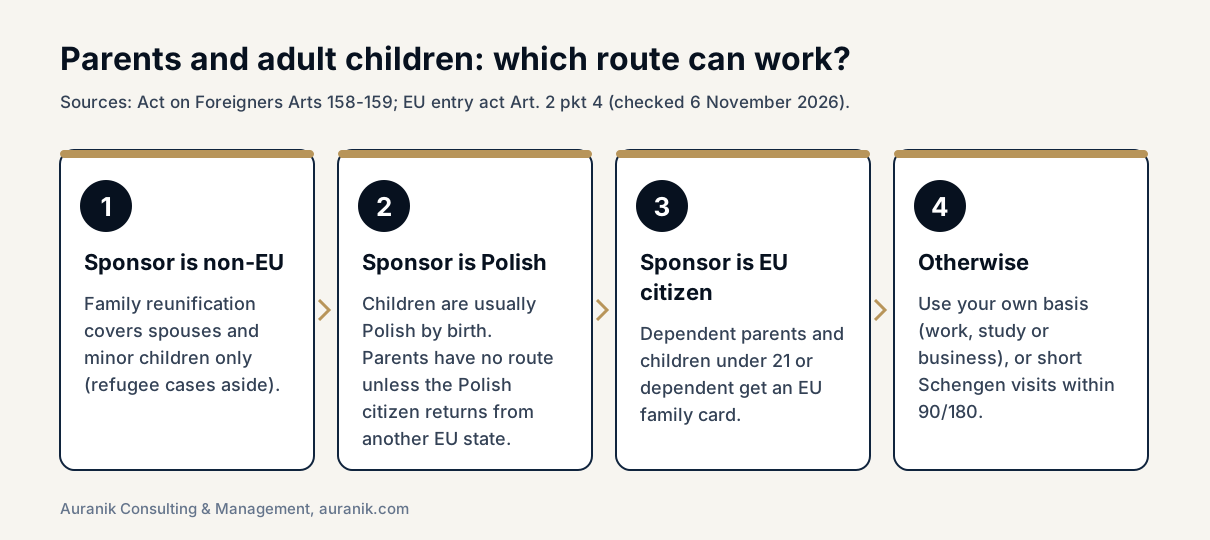
If your relative in Poland is a non-EU foreigner
Article 159 lets a foreigner with a qualifying residence status bring their spouse and their minor children, including adopted and step-children in their care. Being a minor is judged on the day the application is filed. Parents and adult children are not on the list.
The one exception concerns refugees and people with subsidiary protection. If the person in Poland is, or was when applying for protection, an unaccompanied minor, their parent can count as a family member. Outside that situation, a parent or adult child needs a basis of their own.
If your relative in Poland is a Polish citizen
Article 158 covers a foreigner married to a Polish citizen and that spouse's minor child. It has no category for parents. Adult children of a Polish parent, however, are usually Polish citizens themselves by birth and need Polish documents rather than a permit.
The exception is a Polish citizen returning to Poland after living in another EU or EEA country, Switzerland or the UK for more than three months, where family life was built. A parent who depends on that returning Polish citizen can then use the EU family-member card.
If your relative in Poland is an EU citizen
The EU rules are the most generous for this situation. Under the definition in Article 2 point 4 of the 2006 Act on EU citizens' entry and stay, a parent or grandparent of the EU citizen or of their spouse is a family member if they are dependent, and a child or grandchild is covered if under 21 or dependent.
Qualifying relatives apply in person for a free residence card for a family member of an EU citizen, by the day after three months from entry. The office asks for a document confirming that the parent or child is dependent on the EU citizen or their spouse, so dependency has to be shown, not just stated.
When no family route fits
A parent or adult child without a family route can still come on their own basis. A job offer can support a temporary residence and work permit, admission to degree studies supports a study permit, and running a business can support a business permit. Each has its own conditions and fees.
For shorter stays, visits under a Schengen visa or visa-free travel are limited to 90 days in any 180-day period. A parent who visits regularly should count those days carefully before booking each trip, for example with the European Commission's short-stay calculator or the Auranik stay calculator.
Evidence and planning tips
Whatever the route, the relationship must be proven with birth certificates, often with an apostille and a sworn Polish translation. Dependency is assessed case by case, so Auranik suggests collecting evidence early: bank transfers over several months, the parent's income or pension statements, and their household costs at home.
Health insurance and accommodation come up in most routes, so plan who will cover a parent's healthcare in Poland. Older parents may face higher private insurance costs, which affects the total budget for the move.
Next steps
Open the Auranik family-route finder, choose who your relative in Poland is and how you are related, and it shows the route that fits with its documents and sources. If no family route fits, the work, study and business preparation tools explain the alternatives step by step.
Auranik can help assess a borderline case, such as proving dependency, and prepare the documents. Auranik is not a law firm and cannot guarantee a decision, which rests with the voivode. Start here: Open the family-route finder.
Frequently asked questions
Can I bring my parents to Poland on family reunification?
Not if you are a non-EU foreigner living in Poland, unless you have refugee status or subsidiary protection and came as an unaccompanied minor. Article 159 covers spouses and minor children.
Can a parent of an EU citizen live in Poland?
Yes, if the parent depends on the EU citizen or their spouse. They apply for a free residence card for a family member of an EU citizen.
EU family-member route →How long can parents visit Poland without a residence permit?
Up to 90 days in any 180-day period under the Schengen rules, on a visa or visa-free depending on nationality.
90/180 stay calculator →Community content reflects individual experiences and should not be treated as legal, immigration, financial or government advice.
Know someone who may find this guide useful?