The short answer: a citizen, not a foreigner
Families often ask which residence permit a child needs to join a Polish parent in Poland. In most cases the answer is none. Under Article 14 of the 2009 Act on Polish citizenship, a minor acquires Polish citizenship by birth if at least one parent is a Polish citizen, wherever the child is born.
A Polish citizen cannot be given a residence permit in Poland, because they already have the right to live and work there. What the child needs is proof of citizenship in the form of Polish documents: a Polish birth record, a PESEL number and a passport or ID card.
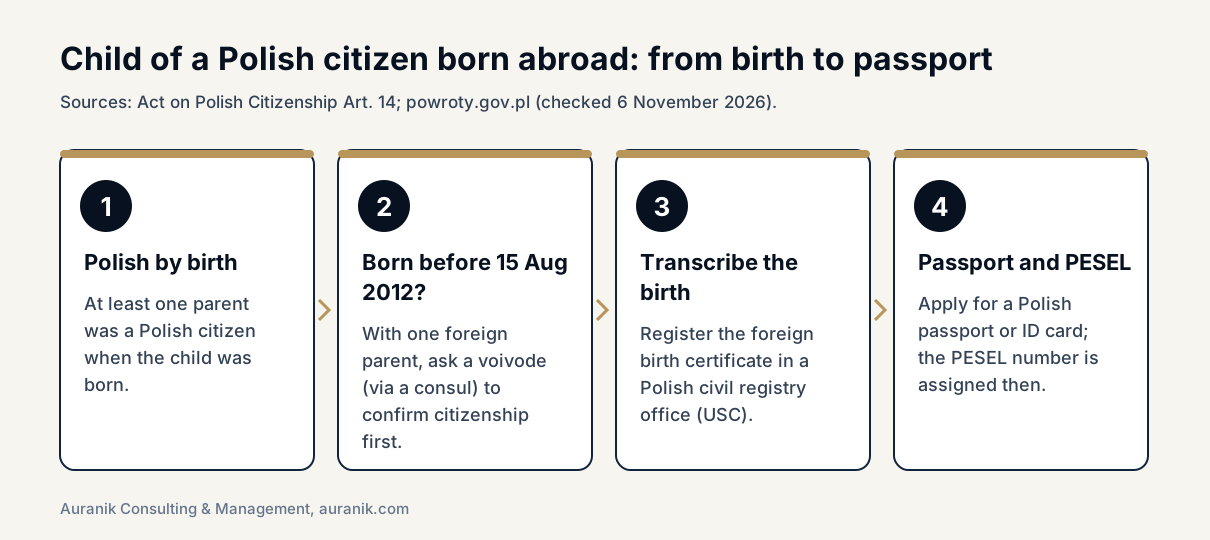
Children born before 15 August 2012
The 2009 Act took effect on 15 August 2012. The government returnee portal powroty.gov.pl explains that for a child born before that date to one Polish and one foreign parent, a decision confirming Polish citizenship may be needed first, because the earlier law let parents choose a foreign citizenship for the child.
That confirmation is decided by a voivode, or by the Mazowiecki voivode if the child has never lived in Poland, and from abroad the application can be filed through a Polish consul. Once confirmed, the child follows the same document steps as a child born after 2012.
Step one: transcribe the foreign birth certificate
Before applying for a Polish passport or ID card, the foreign birth certificate has to be entered into the Polish civil register. This is called transcription, or transkrypcja, and a Polish civil registry office (USC) carries it out, creating a Polish birth record. From abroad, you can file through the Polish consulate for your country, which forwards the application to the USC you choose.
Consular pages list the application, the original foreign birth certificate showing both parents' names, and a translation by a Polish sworn translator, an EU or EEA sworn translator, or the consul. Some supporting documents may need an apostille or legalisation, and consulates charge a fee, so check your consulate's page before you start.
Step two: passport, ID card and PESEL
With the Polish birth record in place, a parent applies for the child's Polish passport or ID card. According to powroty.gov.pl, the PESEL number is assigned automatically during that application, so you do not need a separate PESEL request.
For a person born abroad who is not registered as living in Poland, a Polish birth record made by transcription is a condition for assigning a PESEL. That is why transcription comes first even if you only want a PESEL for school, healthcare or a bank account.
What if the parent is a citizen of another EU country
If the parent is not Polish but a citizen of another EU or EEA country or Switzerland, the child is not a Polish citizen through that parent. Instead, a child who is not an EU citizen can apply for a residence card for a family member of an EU citizen, which covers children under 21 and older children who depend on the parent.
That card is free, applied for in person with the voivode, and must be requested by the day after three months from entry. A child who already holds an EU citizenship of their own needs no card at all and simply registers their stay if staying longer than three months.
Cases that need a closer look
Citizenship questions can be complicated. The parent must have been a Polish citizen at the moment of the child's birth, and history matters: a parent who lost or renounced Polish citizenship before the birth changes the answer, and some transcription cases have been contested in administrative courts.
If any of this applies, ask a Polish consul or the voivode before relying on the citizenship route, and keep copies of every certificate the parent holds. Auranik can help organise the documents and translations, but it is not a law firm and cannot confirm citizenship.
Next steps
Order the full foreign birth certificate with both parents' names, arrange a sworn translation and any apostille, and decide whether to file the transcription with a civil registry office in Poland or through the consulate. For a child born before 15 August 2012 with one foreign parent, start the citizenship confirmation first.
Then apply for the passport or ID card, which brings the PESEL with it. The Auranik family-route finder on the immigration pages shows the same answer for each family situation, including children of EU citizens and of foreigners living in Poland. Start here: Open the family-route finder.
Frequently asked questions
Does a child of a Polish parent need a residence permit in Poland?
No. A child with at least one Polish parent is a Polish citizen by birth under Article 14 of the Act on Polish citizenship and needs Polish documents, not a permit.
How does a child born abroad get a PESEL?
Transcribe the foreign birth certificate into the Polish civil register, then apply for a Polish passport or ID card; the PESEL is assigned in that process.
What changes for a child born before 15 August 2012?
With one foreign parent, a decision confirming Polish citizenship may be needed first, from a voivode or, via a consul, the Mazowiecki voivode.
Community content reflects individual experiences and should not be treated as legal, immigration, financial or government advice.
Know someone who may find this guide useful?